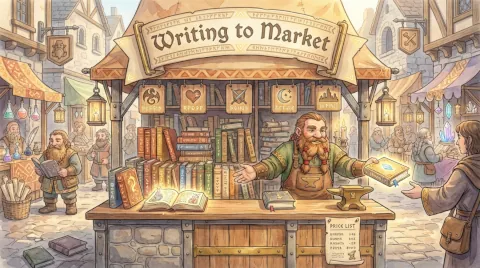
Writing to Market Isn't Chasing Trends
A writer's guide to positioning your book in the right micro-market so readers who will love it can actually find it, without sacrificing your unique voice or artistic vision.
Write to Market
You've heard the advice before: "Write to market." And if you're like most writers, you've probably recoiled from it.
It sounds like:
- Writing cookie-cutter books that all blend together
- Chasing trends on Amazon like some kind of content mill
- Abandoning everything that makes your voice unique
- Becoming a soulless production machine instead of an artist
The phrase itself carries a whiff of compromise, of "selling out", of betraying whatever called you to writing in the first place.
But then you finish your book. The one you poured your heart into for two years. You've revised it eight times. Beta readers loved it. You know it's good.
You publish it, and... nothing. Silence.
Maybe three reviews from family members. Sales that barely register. No traction whatsoever.
Meanwhile, you check the bestseller lists and see books you privately consider "generic" dominating the charts. Books that seem to follow obvious formulas. Books with covers that look like ten other covers you've seen this month. Books with titles that could be Mad Libbed from the same template.
And you feel that painful tension crystallize: Do I have to choose between artistic integrity and actually being read?
The Reframe
Writing to market isn't about becoming generic.
It's about becoming legible to the right readers, in the right subgenre, with the right promises.
Writing a brilliant book that no one can categorize versus writing a brilliant book that readers in your target audience can actually find.
The goal isn't to sand off everything interesting about your work. The goal is to understand what promises you're making and to whom, so that when you make those promises, you keep them. And so that readers who want exactly what you're offering can recognize your book as theirs.
What This Article Covers
- The crucial difference between macro-genres (Fantasy, Romance, Thriller) and competitive micro-markets (Cozy Fantasy with Mature Heroines, Small-Town Romantic Suspense with Law Enforcement Leads)
- Why successful markets are built on reader promises, not originality
- How tropes function as signal flares to readers: "This book is for you"
- Why breaking tropes too early kills your discoverability
- A repeatable method for identifying where your story belongs before you worry about what makes it unique
Who This Is For
This article is for authors who feel genuinely torn between artistic integrity and commercial success.
It's for writers who want to be read, who want their work to find its audience, but who refuse to write soulless content that betrays their vision.
The good news?
You don't have to choose. But you do have to understand how markets actually work.
What "Market" Actually Means
The Common Misconception
When most writers hear "write to market," here's what they imagine:
You check Amazon's top 100 in your genre. You find the #1 bestseller. You note its tropes, its cover style, its page count. You copy those elements as closely as possible into your own book. Then you hope to ride the wave of whatever's trending.
Six months later, you're confused and frustrated. Your "vampire romance with fated mates" isn't selling, despite vampires being "hot right now." Your "cozy mystery with a cat" isn't gaining traction, even though cozy mysteries are supposedly booming.
What went wrong?
Why Macro-Trends Aren't Markets
"Vampires are popular" is not actionable intelligence. It's like saying "People buy blades." Technically true, but completely useless for a smith who needs to know: What kind of blades? For whom? At what price point? With what specific features and proportions?
A market isn't a trend you chase. A market is an ecosystem you understand and serve.
The Real Definition
A market is:
- A specific group of readers
- With specific expectations about what they're buying
- Looking for specific emotional experiences
- Using specific signals to find books that will deliver those experiences
Markets aren't fleeting trends that appear and vanish in six months. They're reader communities with established preferences, developed over years of reading.
Some markets are huge. Some are tiny niches.
But they all operate on the same principle: readers know what they want, and they've learned to recognize the signals that indicate a book will give it to them.
The Market Hierarchy
MACRO-GENRE (too broad to be useful for positioning) Fantasy └── SUBGENRE (getting warmer, but still not specific enough) Romantasy └── MICRO-MARKET (this is where you actually compete) Slow-burn fae romance with political intrigue Steamy shifter romance with small-town settings Friends-to-lovers academy romance with found family Dark immortal romance with morally gray love interests
Look at that structure carefully. Each level down gets more specific, until you reach the micro-market—the actual competitive space where your book lives or dies.
Five Elements That Define a Micro-Market
When you're identifying your micro-market, you need to get extremely granular. Here are the five elements that define where you actually compete:
1. Reader demographics and lifestyle
- Not just age, but reading habits.
- Do they read one book a month or fifty?
- Are they looking for comfort reads before bed or intellectual challenge?
- Do they have thirty minutes or three hours for a reading session?
2. Emotional promises and tone
- Is this comfort or stress?
- Cozy or dark?
- Hopeful or bleak?
- High steam or closed door?
- Laugh-out-loud funny or dry wit?
Readers often choose books based on the mood they're in right now.
3. Trope clusters
Not just one trope, but the combination.
Enemies-to-lovers shows up in both sweet contemporary romance and dark mafia romance, but those are completely different micro-markets because the surrounding tropes are different.
4. Setting expectations
Contemporary small town feels completely different from Regency England, which feels different from secondary-world fae courts. The setting isn't just backdrop—it's part of the promise.
5. Pacing and structure preferences
- Slow-burn versus instant attraction.
- Literary and meandering versus fast-paced and plot-driven.
- Multiple POVs versus single.
- First person versus third.
These aren't just stylistic choices, they're signals that tell readers whether this book is for them.
An Example in Practice
If you tell readers "I write fantasy," you've told them essentially nothing useful.
If you tell them "I write cozy fantasy with tea shop settings, no romance, found family vibes, and low-stakes mysteries where nobody dies and everything works out okay in the end," readers know immediately whether that's for them.
One reader's eyes light up: "Yes, that's exactly what I want right now."
Another reader moves on: "Not for me, I need higher stakes."
Both of those are good outcomes. You've helped readers self-select accurately.
The problem isn't that some readers don't want your book. The problem is when no readers can figure out if they want it because you haven't been clear about what you're offering.
Markets Are Built on Promises, Not Originality
The Originality Trap
Here's what new writers often believe, with great conviction:
- "My book is unique because it's unlike anything else out there"
- "I'm blending genres in a way that's never been done before"
- "The market is oversaturated with similar books, so the only way to stand out is to be completely different"
This sounds logical. It sounds like good advice. But it's also almost completely backwards.
Why "Completely Different" Backfires
Readers don't buy books because they're "unlike anything else."
Readers buy books because they're similar to those they already love, with a fresh twist that makes the experience feel new.
Think about how you choose what to read. You don't usually browse looking for something utterly alien to your taste. You look for books that promise an experience you've enjoyed before, with enough variation to be interesting, but not so much that you're unsure what you're getting.
When you picked up your favorite book in your favorite genre, you probably chose it because the cover, title, and blurb signaled: "This is the kind of thing you like."
Then you stayed because the book delivered on that promise while also surprising you in satisfying ways.
That's how markets work. Reliability first, then delight in the details.
The Two-Promise Framework
Every successful book makes two simultaneous promises to its readers:
The Baseline Promise (Market Promise)
"This book will deliver the core experience you came here for."
Examples:
- Romance: "These two people will end up together in a satisfying relationship, and the journey will make you feel things."
- Mystery: "A puzzle will be presented, clues will be available, and the mystery will be solved by the end."
- Cozy Fantasy: "You'll feel comforted, not stressed. There will be found family, low stakes, and a happy ending."
- Thriller: "Someone is in danger, tension will escalate, and there will be a climactic confrontation."
This is the contract you make with readers when you position your book in a particular micro-market. Break this promise, and readers feel betrayed, even if your book is beautifully written.
The Differentiation Promise (Your Voice)
"But I'll deliver that experience with this specific twist, angle, or style that makes it mine."
Examples:
- Romance: "But it's enemies-to-lovers with a morally gray necromancer hero who's trying to save his city."
- Mystery: "But it's set on a sentient spaceship with an unreliable AI detective who might be the killer."
- Cozy Fantasy: "But it's about a middle-aged bookshop owner who accidentally adopts a dragon that keeps setting the poetry section on fire."
- Thriller: "But the protagonist is a deaf cryptographer, and the danger involves a code that only she can break."
This is where your voice lives. This is where you get to be creative, distinctive, original. But—and this is crucial—it only works if you establish the baseline promise first.
The Order Matters Desperately
You must establish the baseline promise before you differentiate.
If you try to differentiate before establishing the baseline, readers don't know what they're looking at. They can't tell if your book is for them. They move on to something more legible.
Consider two books:
Book A: "It's a genre-bending story that defies categorization"
What readers hear: "I have no idea what this is or whether it's for me. The author seems confused about what they're writing. I'll pass."
This might be brilliant literary fiction. It might be terrible and incoherent. Readers can't tell from the positioning, so most of them never find out.
Book B: "It's a cozy fantasy with a tea shop and found family"
What readers hear: "Oh, I know exactly what that is. I love those."
Then you add: "But the protagonist is a retired assassin dealing with PTSD, and the 'tea shop' is actually a cover for a network helping people escape abusive situations."
Now readers know what they're getting (the comfort and structure of cozy fantasy) and they're intrigued by your specific angle (the darker background, the purposeful nature of the "cozy" setting).
They can make an informed choice about whether this book is for them. Many will say yes.
The Reader's Perspective
When readers browse—whether in a bookstore, on Amazon, or through a recommendation—they're asking themselves rapid-fire questions:
- "Will this scratch the itch I have right now?"
- "Will this deliver the emotional experience I'm craving?"
- "Is this too intense for my current mood?"
- "Is this too tame for what I'm looking for?"
- "Is this too slow or too fast-paced for me today?"
If your book doesn't answer these questions clearly and quickly, readers move on. No matter how brilliant your prose is, how unique your concept is, or how much they might have loved it if they'd given it a chance.
You have maybe three seconds to communicate: "Yes, this is for you."
Vague positioning kills more good books than bad writing does.
How Tropes Function as Signal Flares
The Trope Misunderstanding
Many writers—especially those with literary aspirations or MFA backgrounds—view tropes with deep suspicion:
- They're lazy writing
- They're clichés to be avoided
- They're signs of unoriginality
- They're what makes books feel "generic"
If you want to be a serious writer, the thinking goes, you should subvert tropes, avoid tropes, transcend tropes.
What Tropes Actually Are
Here's the truth: Tropes are reader expectations made visible.
They're not clichés. They're not laziness. They're promises encoded in recognizable patterns.
Think of them as a specialized language that readers and writers use to communicate about emotional experiences.
Why Readers Love Tropes
Not because they're "easy" or because readers are unsophisticated.
Because tropes reliably deliver specific emotional experiences that readers have learned to crave.
The Signal Flare Metaphor
Imagine you're lost in the mountains at night. You've been wandering for hours. Then you see a signal flare arc up into the sky in the distance—bright red, unmistakable.
What does that flare tell you?
- Someone is over there
- They're signaling for help or extraction
- You know roughly what to expect when you reach them
- You can decide whether you're able to respond
The flare isn't "lazy signaling." It's functional communication under conditions where clarity matters more than creativity.
Tropes work exactly the same way. They signal across the noise of millions of books: "Readers who love X specific experience, this book is for you. Come here."
Common Trope Clusters and What They Promise
Let's look at a few major tropes and unpack what they actually communicate:
Enemies to Lovers
The promise: Delicious tension, witty banter, slow-burn attraction, the deep satisfaction of watching two people who genuinely dislike each other gradually realize they're perfect for one another.
Reader expectation: Initial antagonism, forced proximity or cooperation, grudging respect, moments of vulnerability, emotional breakthrough, kiss/confession, happily ever after or happy-for-now.
If you promise enemies-to-lovers and deliver "they mildly annoyed each other once and then fell in love," readers feel cheated. The antagonism is the whole point. It's not an obstacle to the romance; it's the foundation that makes the eventual love satisfying.
Found Family
The promise: Emotional warmth, characters who genuinely care for each other, chosen bonds over blood bonds, that powerful sense of belonging after isolation.
Reader expectation: Lonely or isolated protagonist, gradual connection with a group of misfits, small moments of care and protection, someone explicitly says or shows "you're one of us now", the group comes through for the protagonist in their moment of greatest need.
Readers don't want found family to be easy or instant. They want to watch it build, moment by moment, until it becomes unshakeable.
Dark Academia
The promise: Aesthetic richness (libraries, old buildings, autumn leaves, candlelight), intellectual intensity, moral ambiguity, obsessive relationships, atmospheric settings that feel almost like a character.
Reader expectation: Elite or isolated academic setting, forbidden or dangerous knowledge, competitive or secretive atmosphere, homoerotic subtext, someone pays a price for their pursuit of knowledge or belonging.
Dark academia readers want that very specific mood. They want to feel like they're in that world. If you give them a bright, cheerful school story with easy friendships and no moral complexity, you've broken the promise, even if it's well-written.
Why Breaking Tropes Too Early Kills Discoverability
The Rebel Author's Mistake
You've absorbed the advice about tropes and markets. You understand their importance. But you're a creative person, an artist. You want to be original. So you think:
"Cozy fantasy always has happy endings where everything works out. Mine will have an ambiguous, bittersweet ending where the protagonist has to give up something they love. That's more literary and honest!"
Or:
"Everyone does the chosen one trope where the protagonist succeeds. Mine will have the chosen one fail completely and someone else save the world. Subversive!"
Why This Fails Commercially
You've just broken the core promise of the micro-market you're trying to reach.
Readers who pick up cozy fantasy specifically want comfort and resolution. They're often reading it because life is stressful and they need a book that feels like a warm hug. If you deliver ambiguity and bittersweetness instead, you've given them literary fiction wearing cozy fantasy's clothing. They didn't consent to that bait-and-switch.
The issue isn't that your subversive version is bad. The issue is that you've mispositioned it.
The Discoverability Problem
Here's the practical reality: markets work through pattern recognition.
Amazon's algorithm identifies patterns: "Readers who liked Book A also liked Book B, because both deliver X experience in Y setting with Z tropes."
Reader recommendations work the same way: "If you loved Book A, you'll love Book B. Same vibe, similar tropes, different twist."
Genre labels, cover design, comp titles, BookTok hashtags, Goodreads shelves, all of these discovery mechanisms work by identifying patterns and connecting books that deliver similar experiences.
When your book promises X but doesn't deliver, you break the pattern. The algorithm can't figure out where you belong. Readers who wanted X feel disappointed and don't recommend you.
You fall into the void between markets; visible to no one, recommended to no one, discovered by no one.
When You Can Successfully Subvert
After you've established credibility in the market
You've written three or more books that reliably deliver on the core promises of your micro-market. Readers trust you. You have a newsletter with actual subscribers who open your emails. You have a fan base that will follow you into something different.
Now you can say: "Hey, my next book is different. Here's how." And many of your readers will trust you enough to come along.
When you clearly signal the subversion up front
Your marketing explicitly says: "This is a cozy fantasy that asks—what if the comfort was a lie? What if the warm village is hiding something dark?"
Your cover and blurb prepare readers for the twist. You're not trying to trick cozy fantasy readers into buying literary fiction. You're targeting the specific subset of readers who want that subversion.
This is a smaller audience, and you accept that going in.
When you're creating a new micro-market, not trying to fit into an existing one
You're not trying to ride "cozy fantasy" search algorithms and recommendations. You're building your own reader base from scratch through direct relationships, word of mouth, and targeted marketing to readers who explicitly want something different from the mainstream.
This is slow growth. This requires patience and different strategies. But it can work—if you're honest about what you're doing.
The Strategic Positioning Framework
Let's get practical. How do you actually figure out where your book belongs?
The Core Question
*"Where does my book belong in the marketplace, and why would readers in that space want it?"**
Step 1: Identify Your Macro-Genre
This should be relatively obvious, but you need to choose one primary genre:
- Fantasy
- Romance
- Mystery/Thriller
- Science Fiction
- Literary Fiction
- Horror
- Historical Fiction
- Contemporary Fiction
If you're blending two genres, you need to pick the dominant one based on page count and core promise.
For example:
- Romantasy = Romance dominant (the relationship is the plot; the fantasy is the setting and conflict)
- Romantic Fantasy = Fantasy dominant (the quest/adventure is the plot; the romance is a subplot)
This distinction matters enormously for positioning.
Step 2: Narrow to Subgenre
Within your macro-genre, what's the general flavor?
Fantasy, for instance, breaks into:
- Epic/High Fantasy
- Urban Fantasy
- Cozy Fantasy
- Grimdark
- Historical Fantasy
- Paranormal Romance
- Romantasy
- Contemporary Fantasy
- Fairy Tale Retellings
- Portal Fantasy
Each of these has different reader expectations, different typical structures, different emotional promises.
Step 3: Identify the Micro-Market
This is the crucial step where most writers don't go deep enough.
Use this formula to get specific:
[Subgenre] + [Setting] + [Protagonist Type] + [Tone/Mood] + [Core Trope Cluster] + [Heat/Violence/Stakes Level]
Example A: Cozy Fantasy
- Subgenre: Cozy Fantasy
- Setting: Small village with a tea shop
- Protagonist: Middle-aged woman, former adventurer who retired, wants peace and quiet
- Tone: Warm, low-stakes, gentle humor, found family
- Tropes: Slice-of-life, cozy mystery elements, community building
- Level: No on-page violence, no romance (or closed-door if present), stakes are personal not world-ending
Micro-market description: "Cozy fantasy with mature heroines, tea/food focus, found family, no romance, low stakes, gentle mysteries"
Example B: Romantasy
- Subgenre: Romantasy
- Setting: Fae court with complex political intrigue
- Protagonist: Human woman thrust into dangerous fae politics
- Tone: Dark, high tension, morally gray characters, lush descriptions
- Tropes: Enemies-to-lovers, forced proximity, fated mates (with resistance), political machinations
- Level: High steam, medium violence, world-level stakes, morally complex
Micro-market description: "Dark fae romantasy with enemies-to-lovers, high steam, morally gray love interest, political intrigue, forced proximity"
Notice how specific these are. You could write two completely different books that both fall under "Fantasy," but they serve entirely different micro-markets with almost no reader overlap.
Step 4: Research Your Micro-Market
Now that you know where you belong, it's time to study that specific space.
Find 10+ Successful Comp Titles
Go to Amazon. Search using your micro-market keywords. Look at the bestseller lists in the most relevant categories.
You're looking for books that:
- Have strong sales rank (generally under 100,000)
- Are recent (published in the last 3 years)
- Have substantial reviews (100+ reviews with 4+ star average)
- Make similar baseline promises to yours
Don't pick the absolute biggest bestsellers (you're not competing with Sarah J. Maas or Colleen Hoover). Pick books one tier down, successful but not phenomenon-level.
Identify the Baseline Promises
The blurb: What tropes does it emphasize? What's the hook? How is it structured?
The reviews: What emotional experiences do readers mention? What did they love? What disappointed them? (Negative reviews often reveal broken promises)
The cover: What's the color palette? What imagery is used? What tone does it convey?
The title: What's the format? (Single word? Phrase? "The X of Y" structure?)
Map the Patterns
- **Common story structures
- Typical protagonist journeys: What kind of character arc is standard?
- Expected ending types: HEA (happily ever after)? HFN (happy for now)? Bittersweet? Open-ended?
- Pacing norms: Fast-paced action? Slow-burn relationship development? Literary and contemplative?
- Word count ranges: Are most books 80k? 100k? 120k+?
- POV patterns: First person? Third? Multiple POVs? Single?
- Series expectations: Standalones? Trilogies? Ongoing series?
If 8 out of 10 books in your micro-market:
- Use single-POV first person, that's the reader expectation
- Clock in at 80-100k words, that's the expected length
- Feature covers with dark backgrounds and a single figure, that's the visual language of the market
- End with explicit HEA, that's part of the core promise
These patterns aren't arbitrary. They've emerged because they serve the specific needs and preferences of readers in this micro-market.
Step 5: Position Your Book
Now you can finally articulate your positioning:
"My book is [Micro-Market] + [Your Specific Twist]"
Here are some examples:
"My book is small-town romantic suspense with a law enforcement hero and enemies-to-lovers (baseline promise), but the heroine is a true crime podcaster investigating cold cases, and both leads are neurodivergent (differentiation)."
"My book is cozy fantasy with a tea shop and found family (baseline), but the protagonist is managing chronic pain and the 'magic' is actually about creating accessibility accommodations in a fantasy world (differentiation)."
"My book is dark fae romantasy with enemies-to-lovers and high steam (baseline), but the fae love interest is actually the villain from a previous generation's story, and the book explores his redemption arc (differentiation)."
The Critical Rule
Your differentiation should enhance the core promise, not replace it.
The tea shop cozy fantasy should still be cozy. The chronic pain adds depth and representation, but it doesn't turn the book into a dark, depressing meditation on suffering.
The romantasy should still deliver the enemies-to-lovers romance. The villain redemption arc adds complexity, but readers still get the romance they came for.
If your "twist" fundamentally breaks the promise of your micro-market, you're not positioned correctly. You need to either adjust the book or find a different micro-market where you're actually delivering what readers want.
Common Objections
"But This Sounds Like Selling Out"
The objection: "If I'm just giving readers what they want, where's the art? Where's my voice? Isn't this just cynical commerce?"
Here's the truth: "Selling out" would be writing a book you hate, in a genre you despise, purely to chase money.
Strategic positioning is writing the book you love, then describing it in a way that helps the right readers find it.
Your book doesn't change. Your craft doesn't diminish. You're just being clear about what you're offering and who it's for.
"What About Literary Fiction? What About Art?"
The objection: "Literary fiction doesn't follow market rules. Real art transcends markets. This advice is for genre writers, not serious literature."
This is perhaps the most persistent myth in publishing.
Literary fiction is a market. It's just a different market with different distribution channels.
Literary fiction has micro-markets too:
- Domestic literary fiction with family drama
- Experimental/avant-garde
- Historical literary with lyrical prose
- Contemporary realism with social commentary
Literary readers have expectations. The expectations are just different from genre fiction:
- Beautiful prose over plot velocity
- Ambiguity over neat resolution
- Character interiority over external action
- Thematic depth over pure entertainment
- Sentences worth reading twice
Literary fiction readers know what they want. They browse differently (literary journals, NPR reviews, indie bookstore recommendations, MFA networks), but they're still looking for signals that a book will deliver the experience they crave.
A literary novel still needs to be positioned correctly. It still needs comp titles. It still needs to signal who it's for.
The market is smaller. The commercial expectations are different. But it's still a market.
"Won't This Make All Books the Same?"
The objection: "If everyone follows these rules, won't every book in a micro-market be identical? Isn't this the death of originality?"
Look at the top 20 books in any micro-market. They all deliver the core promises—enemies-to-lovers follows a certain arc, cozy fantasy has certain tonal elements, thrillers escalate tension in recognizable ways.
But each successful book has:
- A distinctive voice
- Unique characters
- A fresh angle on familiar tropes
- Particular strengths (maybe the dialogue, maybe the worldbuilding, maybe the emotional depth)
- The author's specific obsessions and interests
Readers don't want randomness. They want reliable variation.
They want to know they'll get the emotional experience they came for, delivered in a way that feels fresh enough to be interesting.
Final Thoughts
At the end of the day, “write to market” isn’t a command to hollow yourself out; it’s an invitation to stop hiding what you’ve already made.
You’re not being asked to turn your strange, sharp, specific book into a bland product. You’re being asked to choose a stall in the marketplace, hang a sign that actually matches what’s on your table, and speak in a language your ideal readers already understand.
Sarah would put it this way:
If you forge a beautiful blade and then toss it in the scrap heap, that’s not integrity. That’s waste.
Positioning is not the enemy of art; it’s the bridge between your art and the people it was meant for.
Markets are just reader communities. Tropes are just shared shorthand for emotional experiences. Micro-markets are just places where readers with the same itch gather to have it scratched.
You can either pretend you’re above all that and stay invisible, or you can learn the language well enough to say, clearly and honestly, “Hey—if you love this kind of thing, mine belongs with yours.”
You do not have to write for everyone. In fact, you can’t. But you can decide who you’re writing for and then make it stupidly easy for them to recognize themselves in your cover, your title, your blurb, and your tropes.
So here’s your practical next step—no spreadsheets required:
- Name your micro-market in one sentence:
“I write [subgenre] with [setting], for readers who want [emotional tone], featuring [core trope cluster], at [heat/violence/stakes level].” - List 5–10 selling books that sit close to that sentence. Study their promises.
- Write your own two promises:
- Baseline: “If you pick up my book, you will get X.”
- Differentiation: “And you’ll get it in this specific way: Y."
- Audit your packaging (title, cover, blurb, keywords) and ask: “Would a reader of those comp books instantly understand that this is for them?”
If the answer is no, your craft is not the problem. Your legibility is.
You’re allowed to keep your weirdness, your edges, your obsessions. You’re allowed to make art that would make a committee nervous. But if you want that art to actually be read. If you want your stories living in other people’s heads instead of just your hard drive. You owe it to yourself to learn how the market really works.
Not so you can become a different kind of writer. So you can finally stop shouting into the void and start speaking directly to the readers who’ve been waiting for exactly what you make.