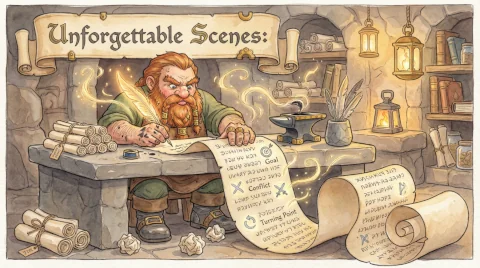
Forging Unforgettable Scenes: Goal, Conflict, and Turning Point
Learn the fundamental building block of great stories.
Introduction: The Scene as Crucible
Every story is carved from moments where something must give.
Not the wandering strolls through memory, not the idle descriptions of mountain mist — those have their place — but the tight, pressurized crucibles where a character wants something, collides with opposition, and emerges changed.
Sarah taps the side of a stone crucible in her forge. “This,” she says, “is your scene. You pour in goal, you feed it conflict, and you wait for the turning point; the moment where the metal must change, or crack.”
In this lesson, she narrows her focus to the scene:
- as a crucible of pressure,
- as an instrument of value change,
- and as the place where stories either ignite or quietly go cold.
You’ll learn:
- How to design every scene around goal, conflict, and outcome.
- How to track a measurable value shift from start to finish.
- How to diagnose flabby scenes that leak pressure.
- How to revise them so each one ends hotter than it began.
Think of this article as a small workshop at Sarah’s anvil, complete with templates, question lists, and a before/after scene repair.
I. What a Scene Really Does: From Neutral Stone to Tempered Steel
Many apprentices mistake scenes for “stuff happening”: banter, travel, exposition, lore dumps. Mountains of words; very little metal.
Sarah disagrees.
“A scene,” she says, “is a sealed chamber in the mountain. Once you close the door, the pressure must rise until something inside cannot stay the same.”
So a working scene does three things:
Starts with a clear, active goal.
Someone wants something now, in this time and place.Meets escalating conflict.
The goal is frustrated by obstacles: people, environment, inner doubt, bad timing.Ends in an outcome that turns the story.
The character either succeeds, fails, or gets something different than expected, and the underlying value (safety, trust, hope, status, etc...) moves from one state to another.
That third piece is where most scenes fail. The events happen, but nothing actually turns. The emotional change stays flat: safe → safe, neutral → neutral, grumpy → grumpy.
No turn, no heat. No heat, no memory.
II. The Three Pillars: Goal, Conflict, Outcome
Let’s walk into three different dwarven scenes and watch how these pillars work.
1. Goal — What Does the Character Want Right Now?
A scene goal is not a life purpose or a vague desire. It’s a specific, active objective in this moment.
- Bad: “He wants to be respected.”
- Better: “He wants the High Council to approve his mining proposal today.”
- Best: “He wants Councilor Thrain, specifically, to cast the deciding vote in his favor.”
The more concrete the goal, the easier it is to build conflict.
Dwarven Council Chamber Example (Goal)
Scene opening:
- Location: Council chamber beneath the mountain, torches guttering in stale air.
- POV: Apprentice miner, Darrik.
- Goal: Get permission to reopen Tunnel 7 before the watch-bell.
Not “he wants approval someday.” Not “he hopes they listen.”
He must walk out of this chamber with a stamped rune-slate today, or his trapped crew will suffocate.
We have a crucible.
Questions to sharpen your scene goal:
- What does my character want to get, do, or avoid in this scene?
- Can I phrase it as: “If I walk away from this moment with X, I win. If not, I lose.”?
- Is someone else in the scene opposed to that goal?
If you can’t answer these, you don’t yet have a scene; just people in a room.
2. Conflict — What Fights Back?
Once the goal is clear, conflict is everything that says “No.”
Conflict can be:
- External–Personal: another character with a clashing goal (Councilor Thrain doesn’t want Tunnel 7 reopened).
- External–Situational: collapsing tunnels, strict laws, time limits, dangerous rituals.
- Internal: fear, shame, doubt, conflicting loyalties.
Sarah’s rule: “If the metal faces no resistance, you are not forging; you’re just warming it.”
Collapsing Tunnel Example (Conflict)
New scene: Darrik leads a rescue crew into Tunnel 7, which is already unstable.
- Goal: Reach the trapped miners before the air gives out.
- Conflict:
- Support beams groaning, raining dust.
- A veteran foreman refuses to go deeper after seeing a crack pattern that signals imminent cave-in.
- Darrik’s own terror of being buried alive (his father died in a similar collapse).
Conflict is not just “bad vibes.” It’s forces that realistically threaten to block the goal.
Questions to sharpen conflict:
- Who or what has the power to say “no” to this goal?
- How do they escalate resistance as the scene progresses?
- What inner fault-line (fear, wound, belief) cracks under that pressure?
3. Outcome & Turning Point — What Cannot Go Back?
The turning point is the moment where the rising pressure forces a decisive shift in value.
It’s the hinge where:
- survival tips to sacrifice,
- trust tips to suspicion,
- hope tips to despair (or vice versa).
Think of it as the instant when the crucible pops; the scene must leave your character somewhere new.
Tense Forge Argument Example (Turning Point)
Scene: In the forge, Sarah and her best hammer-smith, Brokk, argue over whether to arm the surface kings with dwarven weapons.
- Goal (Sarah): Convince Brokk to forge the blades under strict conditions.
- Conflict: Brokk refuses; he’s seen surface wars gut entire valleys. Their argument heats from professional to personal.
- Turning Point: Brokk smashes his hammer through a nearly finished blade and says, “If you order me, I’ll leave the mountain.”
The value shifts:
- Loyalty → Fractured loyalty
- Control → Loss of control for Sarah
- Stability → Instability in the forge hierarchy
A turning point:
- cannot be undone immediately,
- forces a different next scene than the one you’d planned before it,
- and often presents a new question or dilemma.
Questions to nail the turning point:
- What single moment forces the character’s situation from one value to another?
- After this moment, what can no longer be the same between these characters?
- How does this outcome create a new problem or cost?
III. Value Shifts: How to Measure the Heat of a Scene
Goal, conflict, outcome are the tools. Value is the metal you’re actually shaping.
A story value is a spectrum that matters deeply to your character:
- safety ↔ danger
- belonging ↔ isolation
- respect ↔ humiliation
- hope ↔ despair
- power ↔ powerlessness
- honor ↔ disgrace
In a strong scene, you can describe the starting value and ending value in one clear stroke:
“The scene begins at cautious trust and ends at open hostility.”
Sarah’s guidance: “If you cannot name the value at the start and the value at the end, you have no proof the metal changed.”
Simple Value Shift Table
When revising, you can sketch each scene like this:
| Scene # | Location | Goal (for POV character) | Start Value | End Value |
|---|---|---|---|---|
| 7 | Council chamber | Get Tunnel 7 reopened today | Hopeful / low status | Desperate / rejected |
| 8 | Collapsing Tunnel 7 | Rescue trapped miners before air runs out | Risk accepted | Lives lost / guilt |
| 9 | Forge argument w/ Brokk | Persuade Brokk to forge weapons under strict conditions | Mutual trust | Trust fracture |
Your minimum standard for a working scene:
Start Value ≠ End Value
It doesn’t always need to flip to the opposite, but it must move enough that the story feels like it progressed.
IV. How to Spot Flabby Scenes
Flabby scenes are the ones you keep skimming in your own manuscript. Nothing really happens; lots of words, little pressure.
Sarah’s diagnosis usually lands in one of three categories:
- No clear goal.
- Mushy conflict.
- Flatline ending.
Let’s walk through each.
1. No Clear Goal
Signs:
- The POV character mostly observes or reacts.
- Conversations meander from topic to topic.
- You’d struggle to answer: “What did they want when they walked into this room?”
Fix:
- Rewrite the opening paragraphs to declare or imply a concrete objective.
- Add a time pressure, stakes, or specific ask.
Instead of: “They chatted with the council about the tunnels.”
Use: “Darrik had three minutes to convince the council to reopen Tunnel 7, or his trapped crew became ghosts he’d never stop hearing.”
2. Mushy Conflict
Signs:
- Everyone is roughly on the same side.
- Obstacles are minor and easily brushed past.
- Arguments resolve quickly, often with instant agreement.
Fix:
- Give at least one opposing force credible power to say “no.”
- Make that force’s position reasonable, not cartoonishly evil.
- Escalate: each exchange should raise the cost or risk.
Example in the council chamber:
Instead of vague worry:
“Some dwarves were worried about safety.”
Be specific and consequential:
“Councilor Thrain holds the seal to reopen tunnels; and his son died in Tunnel 7. He’d sooner collapse the whole level than risk another crew.”
Now conflict has teeth.
3. Flatline Ending
Signs:
- Scene simply stops when the information is delivered.
- The POV character feels the same as at the start.
- The situation is unchanged; the next scene could be the same either way.
Fix:
- Push the conflict until someone makes a costly decision or suffers an unexpected blow.
- Ask: “What’s the worst plausible way this could go right now?”
- Choose a turning point that changes the direction of the next scenes.
Sarah’s maxim: “Never leave the forge cold. End each scene hotter than it began.”
V. A Simple Scene Outline Blueprint (Template + Questions)
Use this when planning or revising any scene.
Scene Blueprint
Anchor (1–3 sentences)
- Where are we? When? Who’s present?
- What has just happened that makes this scene necessary?
Goal (1 sentence)
- “[Name] wants to [specific action/result] right now.”
Stakes (2–4 bullets)
- What happens if they succeed?
- What happens if they fail?
- Who else is impacted?
Conflict Path (3–5 beats)
- Beat 1: First obstacle appears.
- Beat 2: Reversal or complication.
- Beat 3: Personal pressure (inner fear, old wound).
- Beat 4: Crisis: they must choose.
Outcome & Turning Point (2–3 sentences)
- What happens?
- How does the value shift (X → Y)?
- What new question or problem arises?
Exit Hook (1–2 sentences)
- A line, image, or decision that points directly into the next scene.
VI. Before & After: Repairing a Weak Scene
Let’s watch Sarah at work on a flabby draft.
Draft Scene (Before)
The council chamber was crowded and noisy. Darrik stood at the back, listening to the dwarves argue about Tunnel 7. Some thought it should stay closed, others thought it should be reopened. After a while, the High Councilor banged his hammer for silence and said they would think about it. Darrik left, wondering what would happen next.
What’s wrong?
- No stated goal for Darrik (he’s just “listening”).
- Conflict is vague (“some” vs “others”).
- Outcome is a non-decision (“we’ll think about it”).
- Value: uncertainty → uncertainty. The metal never heats.
Sarah snorts. “This is not a scene; it’s a meeting that could have been a rumor.”
Revised Scene (After)
The council chamber felt smaller than the tunnel that had collapsed.
Darrik squeezed the cracked rune-slate between his palms and stared at the High Council’s stone bench. Three torches left smoke halos in the stale air. In less than an hour, the air would be gone from Tunnel 7 as well.
“Apprentice Darrik Stonehand,” the herald called. “You petition the Council regarding a sealed tunnel?”
Darrik stepped forward. His knees wanted to shake; he locked them. “Yes, honored councilors. I request immediate reopening of Tunnel 7 to retrieve the trapped crew before they—”
“Denied.” Councilor Thrain didn’t bother to stand. The old dwarf’s beard-rings clinked as he shook his head. “The tunnel is unstable. We will not risk another collapse.”
Darrik swallowed. “Sir, with respect, we can brace the supports and—”
Thrain’s gaze cut him in half. “My son’s bones are still under that rock. Do you propose we bury more sons with him?”
The chamber fell silent. No one met Darrik’s eyes.
“Councilor,” Sarah said softly from the end of the bench. “There may be another way. A small rescue crew, properly equipped—”
“You of all dwarves should know when a vein is lost.” Thrain struck the bench with his hammer. “The matter is closed. No crews. Tunnel 7 remains sealed.”
Darrik’s fingers dug into the rune-slate until it cracked cleanly down the center.
He bowed because his legs would not let him do anything else.
As he turned to leave, Sarah’s voice followed him, low and urgent. “If you go, you go without the Council’s blessing. Do you understand what that means, Stonehand?”
The chamber door thudded shut behind him like the plug of a tomb.
Darrik looked at the broken slate in his hand. Council blessing or not, his crew was still breathing; for now.
“I understand,” he whispered.
What Changed (And Why It Works)
Goal:
- Before: Darrik has no active goal.
- After: Darrik seeks immediate permission to reopen Tunnel 7 for a rescue.
Conflict:
- Before: faceless “some” vs “others.”
- After: Thrain is a powerful, personally motivated obstacle; the risk is specific (another collapse) and emotional (his dead son).
Outcome & Turning Point:
- Before: “We’ll think about it.” Nothing really resolved.
- After:
- The Council definitively denies the request.
- The value shifts lawful obedience → forbidden defiance.
- Turning point: Darrik chooses to defy the Council and go anyway, setting up the next scene (the unauthorized rescue).
Value Shift:
- Start: Hopeful, lawful attempt to solve the problem through proper channels.
- End: Desperate, risky commitment to go rogue.
The scene now ends hotter than it began; with more tension, more risk, and a path the character cannot easily step back from.
VII. Practical Scene-Revision Checklist
When you audit a scene, walk through this list as Sarah would:
Goal Check
- Can I state the POV character’s immediate goal in one sentence?
- Is it active (something they do), not passive (something they hope)?
Conflict Check
- Who or what opposes this goal with real power?
- Does the resistance escalate (each exchange raising the stakes)?
- Does the conflict hit the character’s inner fault-lines?
Outcome & Turn Check
- Is the outcome decisive, not vague?
- Can I name the value change: X → Y?
- Does the result close some doors and open others?
Leak Check (Pressure)
- Are there long stretches of dialogue or description where the goal stalls?
- Can I cut, compress, or combine beats so pressure never fully drops?
Next-Scene Hook
- Does the ending force a specific kind of follow-up scene?
- If I removed this scene, would anything in the story break? (If not, fix it or cut it.)
VIII. Workshop Drills from the Forge
Sarah often gives her apprentices small drills to train their scene-instincts.
Drill 1: Value Tagging
Take three existing scenes from your draft and label:
- Start Value:
- End Value:
- Goal:
- Turning Point Moment:
If Start Value = End Value, the scene needs surgery.
Drill 2: The Pressure Rewrite
Pick a low-energy scene (you know the one). Without changing the fundamental plot, rewrite it so that:
- The goal is time-limited (“before dawn,” “before the council adjourns,” “before the tunnel floods”).
- The conflict gains one personal edge (someone’s grief, shame, rivalry).
- The outcome costs the protagonist something they thought they needed (reputation, safety, an ally).
Compare drafts. Which one would you rather read aloud in the council hall?
Drill 3: Turn Inversion
Find a scene where the character achieves their goal too easily.
- Ask: “What’s the most dangerous way for them to ‘succeed’?”
- Maybe they get what they asked for, but in a compromised form.
- Maybe success reveals a new, worse truth.
Rewrite so that the turning point twists success into a problem.
Example: Darrik gets permission to reopen Tunnel 7; but only if he leaves half his crew behind and seals the tunnel forever after, dooming other miners further in. Success becomes moral crisis.
IX. Closing Words from the Anvil
Sarah wipes metal dust from her hands and looks you straight in the eye. “Do not waste the reader’s time with cold stone. Every scene you bring them into must be a crucible; a place where want meets resistance, and something soft inside the character hardens or breaks.”
When you shape scenes around goal, conflict, and turning point, and you track a measurable value shift from start to finish, your story stops feeling like a string of events and starts to feel like a sequence of inevitable transformation.
One heated chamber at a time, you forge an experience your readers can’t put down.
And if, during revision, you ever wonder whether a scene earns its place, remember Sarah’s test:
- What does the character want right now?
- What fights back, and how does it escalate?
- What moment forces a value to turn?
- Does the scene end hotter than it began?
If you can answer those clearly, you’re not just stacking pages.
You’re forging unforgettable scenes.