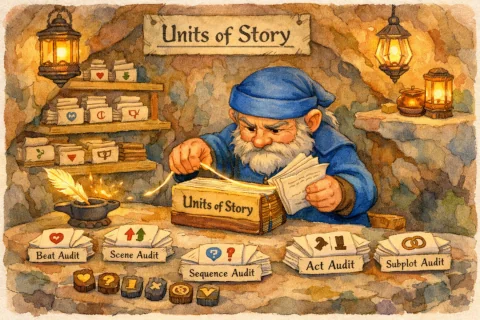
The Units of Story — From the Beat to the Global Story
Learn the six essential building blocks of every great story.
Introduction: The Forge Beneath the Story
Beneath every great saga lies a forge unseen — not of iron and flame, but of moments, choices, and consequences hammered into form. Many young writers mistake the shimmer of a finished tale for its essence, never realizing that the gleam comes from structure: the invisible scaffolding that bears the story's weight.
Sarah begins here: "No dwarven smith strikes at random. Every blow lands with purpose; every spark means something. So too must your story."
In this part of her teachings, she guides apprentices through the six essential "units" of storycraft; the building blocks from which every epic, every fable, and every quiet tragedy is shaped.
These units are the Beat, the Scene, the Sequence, the Act, the Subplot, and the Global Story; each a distinct ring in the chain of meaning. To master them is to understand not only how a story breathes, but how it endures.
I. The Beat — The Smallest Strike
What a Beat Truly Is
A beat is the smallest measurable unit of change. It's a flicker in a character's state; a single emotional pulse.
If a scene is a hammer blow, a beat is the spark that leaps from it.
Sarah teaches: "Each beat shifts the metal; however slightly. The reader may not hear the ring, but they feel the heat."
A beat can alter:
- What a character feels (hope to despair, certainty to doubt).
- What a character wants (from one objective to another).
- What a character knows (truth revealed, assumption shattered).
Dwarven Example:
In the Song of Stone and Smoke, a young apprentice forges his first axe. His master watches in silence. The boy hesitates; beat one: doubt. He strikes and mars the blade; beat two: shame. The master nods, approving the mistake; beat three: humility transformed into growth.
Three beats. Three internal turns. The scene lives.
Editorial Guidance:
- A single beat = one change in value (emotional, informational, moral).
- Beats accumulate like hammer strikes; too few and the metal stays cold, too many and it warps.
- In revision, mark where each beat occurs. If a paragraph or exchange changes nothing — no feeling, no information, no decision — cut or reshape it.
Forge Notes (Practical Takeaway):
When editing, highlight every shift. Ask: Did something change? If not, the beat is false; a clang in the forge.
II. The Scene — Where the Sparks Gather
The Function of a Scene
A scene is a complete exchange of energy that moves the story's central value one notch closer or further from its resolution.
Where the beat is a spark, the scene is a flare; self-contained, visible, and consequential.
Sarah says: "A scene is a sealed crucible; heat builds until change occurs, or the metal cracks."
A well-forged scene must:
- Have a clear value shift (love → hate, ignorance → knowledge, security → danger).
- Be built around a goal, conflict, and outcome.
- End with a turning point that alters what follows.
Dwarven Example:
A council of dwarves debates whether to seal a collapsing mine. Each speaks; arguments clang like tools on stone.
- Value: survival vs. honor.
- Conflict: close the mine (save lives) or rescue trapped kin (risk death).
- Turning Point: when the youngest dwarf steps forward; "I'll go alone."
The decision alters the tribe's fate. One scene; one hammer strike that leaves a dent in the tale.
Forge Notes:
- A scene's energy should be measurable: What value shifts? What's the price of that shift?
- In revision, test the seal; does the scene hold pressure, or does it leak tension?
Editorial Maxim:
"Never leave the forge cold. End each scene hotter than it began."
III. The Sequence — When Sparks Become Flame
The Nature of a Sequence
A sequence is a chain of scenes unified by a single mini-goal or question.
It's where story starts to reveal rhythm; like the repeated swing of the hammer that draws metal into shape.
Sarah calls sequences the forging rhythm: "Each swing aims toward a form. Miss one, and the pattern breaks."
Where scenes are atomic, sequences are architectural.
They answer questions such as:
- Will the dwarves rescue the trapped miners?
- Will the hero confess before the dawn?
- Will the travelers cross the desert alive?
Each scene in the sequence tests one aspect of that question, escalating stakes until the sequence concludes decisively.
Dwarven Example:
In The Ember Deep, a five-scene sequence tracks the forging of a legendary sword.
- Scene 1: Gathering the ore (hope ignites).
- Scene 2: The furnace fails (obstacle rises).
- Scene 3: A rival sabotages the bellows (conflict sharpens).
- Scene 4: The master sacrifices his hammer (cost revealed).
- Scene 5: The sword is quenched in tears (resolution).
Together, the five scenes comprise one sequence: the forging test complete.
Forge Notes:
- A sequence begins with a specific narrative question and ends with an answer; success, failure, or transformation.
- The middle scenes must not repeat; each turn must tighten the coil.
Editorial Guidance:
Map sequences as story arcs in miniature. Label each one with its core question.
If the question feels vague, the sequence will wander; sharpen it until you can state it in one sentence.
IV. The Act — The Full Hammer Rhythm
What Defines an Act
An act is a large-scale movement of story energy that encompasses multiple sequences, each building toward a significant irreversible shift.
Sarah calls it "a full rhythm of the forge: heat, strike, cool, inspect."
Acts shape how readers breathe; they define the pulse of momentum and release.
Four-Stage Pattern of an Act:
- Setup: tools gathered, goal declared.
- Complication: resistance builds; the forge smokes.
- Crisis: metal near breaking; character faces choice.
- Resolution: decision made; new shape revealed.
These mirror the natural process of crafting: deliberate, dangerous, transforming.
Dwarven Example:
Act One of The Forge at Dawn shows a young smith leaving the safety of his mountain to retrieve stolen blueprints.
Across four sequences: the theft, pursuit, encounter, and vow: he learns what he must sacrifice for mastery.
The act ends not with triumph, but with ignition: his forge burns for the first time, symbolizing his readiness for the next act.
Forge Notes:
- Each act should leave the protagonist altered in a way that cannot be undone.
- Acts build emotional endurance; tension must crest, then cool.
- Transitions between acts are quenching moments; readers breathe, reflect, and brace for the next strike.
Editorial Guidance:
When revising acts, inspect pacing. Does each sequence feed the next logically?
Does the crisis ring true? A false crisis is a cracked blade; dramatic but brittle.
V. The Subplot — The Hidden Vein
What Subplots Are For
Subplots are the veins of ore running beneath the main tunnel. They enrich the metal, give it strength and luster, and test its purity.
Sarah's wisdom: "A blade forged from a single metal shatters; mix alloys, and it sings."
Subplots add dimension: emotional, thematic, relational.
They serve four primary functions:
- Contrast: revealing alternate perspectives or moral inversions.
- Reinforcement: echoing the main theme through smaller stakes.
- Complication: creating cross-pressure on the hero's choices.
- Relief: providing emotional texture or pause.
Dwarven Example:
While the main plot of The Molten Path follows a hero reclaiming a cursed forge, a subplot tracks his sister's secret rebellion in the capital.
When the two storylines meet, her betrayal reframes his quest; alloying personal loss with political insight.
Forge Notes:
- Subplots must eventually merge or reverberate with the main story's resolution. Otherwise, they're stray sparks.
- Never introduce a subplot for amusement alone; it must test the same moral metal.
Editorial Guidance:
Trace each subplot's moment of fusion; where it changes the global alloy.
Ask: "Does this vein enrich the blade or weaken it with impurity?"
VI. The Global Story — The Tempered Blade
The Grand Design
The global story is the completed weapon; every beat, scene, sequence, act, and subplot united under one governing value shift.
Sarah calls it "the final temper," where the blade meets the quenching trough and either sings or shatters.
At this scale, the story's question transcends plot mechanics:
- Will the hero preserve integrity in the face of corruption?
- Will the clan endure by adapting, or perish clinging to pride?
- Will knowledge destroy the heart or refine it?
The global story charts the movement from one life value to its opposite, mirrored in every smaller unit.
Dwarven Example:
The Fall of Emberhall begins with unity and ends with division; each act mirrors that fall: alliances fraying, loyalties tested, honor compromised.
In the end, the last dwarf reforges the hall's bell, symbolizing renewal through ruin. Every prior beat contributes to that ring.
Forge Notes:
- The global story must echo through every level. No beat, however small, should contradict the core value change.
- Consistency of theme is the steel's carbon: too little and the blade dulls; too much and it snaps.
Editorial Guidance:
At final inspection, hold your manuscript to the light. Ask:
- What value defines its core?
- What opposite value closes it?
- Do all story units serve this movement?
If yes, you've forged something true.
VII. The Craft of Integration
Aligning the Scales
Understanding the six units means learning to see the story in both micro and macro.
Sarah teaches her apprentices to "read the shimmer of the metal," meaning to trace how energy flows from one level to the next.
| Scale | Story Unit | Key Task | Editorial Question |
|---|---|---|---|
| 1 | Beat | Emotional change | Did something shift within this moment? |
| 2 | Scene | Value change | Does the reader feel the stakes rise or fall? |
| 3 | Sequence | Narrative question | What unites these scenes under one purpose? |
| 4 | Act | Structural transformation | What irreversible choice occurs here? |
| 5 | Subplot | Thematic alloy | How does this thread enrich or pressure the main? |
| 6 | Global Story | Moral movement | What value begins here, and how does it end? |
This table — often etched by apprentices into the side of the anvil — becomes the writer's "Forge Chart."
Dwarven Practice Drill:
When editing, Sarah assigns the Six-Forge Test:
Take one chapter and identify:
- The beats.
- The scene's value shift.
- The sequence question.
- The act's purpose.
- The subplot's contribution.
- The global theme.
Any gap between levels reveals a flaw in the alloy.
VIII. The Rhythm of the Forge (Energy and Flow)
The Flow of Story Energy
Energy must transfer cleanly through all units; from micro beats to the grand arc.
Sarah warns: "A story without rhythm is a forge with no bellows."
Every unit should:
- Build tension (heat).
- Deliver change (strike).
- Offer reflection (cool).
The alternation between compression and release is what keeps readers leaning forward.
Dwarven Example:
In The Long Winter Forge, tension accumulates across three acts, each alternating between frantic forging and long silences in the snow. The reader's breath matches the smith's: inhale, strike, exhale, wait.
Forge Notes:
Balance intensity. Relentless heat melts the reader; too little, and the story cools into disinterest.
Editorial Exercise:
Chart energy visually; assign "temperature" to scenes. High (conflict), medium (transition), low (introspection). Ensure a natural waveform.
IX. The Moral Alloy — Theme Across Units
Every unit carries moral weight; even a single beat can hint at the story's ethics.
Sarah's doctrine: "Every spark carries the metal's nature."
- Beat level: personal choice, emotion and impulse.
- Scene level: immediate consequence, reaction and result.
- Sequence level: pattern of behavior, habit forming.
- Act level: belief tested, identity in flux.
- Subplot level: moral contrast, alternative worldviews.
- Global story: ultimate statement, truth revealed through consequence.
Dwarven Example:
A dwarf lies to spare a friend's feelings (beat). The lie spreads (scene). The clan suffers division (sequence). The liar confesses (act). The friendship fractures but wisdom grows (subplot). The tribe learns to prize truth above comfort (global story).
Moral progression like this turns plot into philosophy.
X. The Editor's Eye — Inspecting the Work
Before Sarah lets any apprentice claim mastery, she demands inspection: a full audit of story integrity.
Checklist of the Six Forges:
- Beat Audit: mark every emotional or informational shift.
- Scene Audit: identify the value swing.
- Sequence Audit: define the core question and its answer.
- Act Audit: trace the irreversible choices.
- Subplot Audit: ensure integration and thematic contribution.
- Global Audit: state the controlling value pair (life/death, freedom/slavery, love/hate, etc.).
Only when all six align does Sarah nod and say: "This tale will endure the ages."
XI. Closing Words from the Forge
"To write is to forge unseen metal. The world may only see the weapon's shine; never the long hours of heat, smoke, and hammering that gave it form."
The six units are not rules, but rhythms. They remind us that a story, like a blade, is built in increments; from spark to strike, from ore to edge.
Sarah's apprentices leave the forge not only knowing how to tell a story, but how to temper one, until every beat rings true and every scene holds its edge.