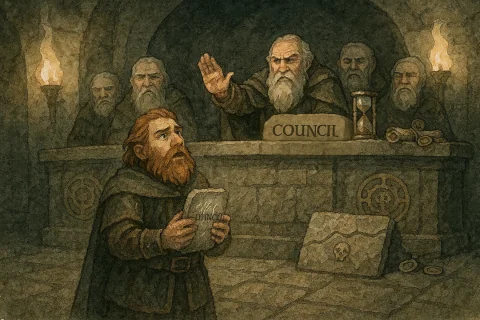
Dwarven Council Scene
Darrik tries to convince the Council to reopen Tunnel 7 and authorize a rescue
The council chamber felt smaller than the tunnel that had collapsed.
The thought lodged in Darrik’s throat like dust. Tunnel 7 had always breathed—wide ribs of stone, steady air drifting from the deep vents, the soft chiming of chisels on ore. Here, in the High Council chamber, the air sat heavy and stale, pressing down as if the mountain meant to crush its own heart.
He squeezed the cracked rune-slate between his palms until the etched symbols bit his calluses. The slate still smelled faintly of smoke and oil from the forge where he’d carved the petition. Beside the great stone bench, three torches spat and hissed, their light barely reaching the vaulted ceiling. Smoke halos clung to the carved lintels like ghostly crowns.
In less than an hour, the air will be gone from Tunnel 7 as well, he thought. The numbers wouldn’t leave him. The crew had been trapped just before second bell. The last report from the knock code stones said their lanterns were still burning, their voices still strong. Now… now he could almost hear them gasping, sharing the last thin breath of stale air.
“Apprentice Darrik Stonehand,” the herald called, voice echoing off stone. “You petition the Council regarding a sealed tunnel?”
The sound rang too loud in the cramped chamber. Darrik felt a dozen pairs of eyes on his back—the scribes hunched at their tables, the guards by the door, the lesser masters standing in the shadows to witness the hearing. He stepped forward anyway. His knees wanted to shake; he locked them as if he were bracing a failing support beam.
“Yes, honored councilors,” he said, forcing his voice into the formal cadence. “I request immediate reopening of Tunnel 7 to retrieve the trapped crew before they—”
“Denied.”
Councilor Thrain Ironmantle didn’t bother to stand. The word dropped from his mouth like a stone into a shaft. His beard-rings clinked as he shook his head, the silver and iron bands catching the torchlight in thin, cold flashes.
“The tunnel is unstable,” Thrain said. “We will not risk another collapse.”
Darrik’s jaw tightened. He had expected resistance. He hadn’t expected to be cut off before he finished his first sentence.
“With respect, Councilor,” he tried again, the formal “sir” strangling on his tongue, “we can brace the supports and—”
Thrain’s gaze snapped to him, sharp as a pick point. The old dwarf’s eyes were a pale, washed-out blue, like quartz leached of color. That gaze cut him in half.
“My son’s bones are still under that rock,” Thrain said, his voice suddenly quiet, almost conversational. That was worse than a shout. “Do you propose we bury more sons with him?”
The chamber went very still.
Darrik heard, with painful clarity, the soft scratch of a scribe’s quill falter and stop. Somewhere behind him, someone shifted their weight and their boot scraped stone; then nothing. No one met Darrik’s eyes. A ripple of pity—or agreement—moved through the room like a draft.
He tasted dust and iron on his tongue. Thrain’s son. He had known, of course. Everyone in the holdfast had known the day the collapse roared through Tunnel 7. But knowing as a story and standing in front of a father who had buried an empty coffin were different things.
“Councilor,” Darrik said, because if he stopped speaking now the crew in Tunnel 7 would suffocate under his silence, “we don’t have to send a full crew. A brace team only—four dwarves, maybe five. We can run new timbers, set wedges, bleed off the pressure. The rock is cracked but it’s not yet resting. If we move fast, we can clear a breathing path.”
Thrain’s beard shifted as his jaw clenched. “You presume to lecture the Council on the behavior of stone?”
“It’s not presumption,” Darrik said, too quickly. “I was there when the first crack sounded. I felt the shift in the floor. It’s not a collapse from the veins themselves; it’s the old fault near the surface. The silver seam is still—”
“Silver.” Another councilor, Master Hafrid Copperveil, snorted softly. “Always silver with you tunnel-rats. You think only in ore and load.”
Darrik turned his head slightly, enough to see Hafrid’s thick fingers drumming irritably on the bench arm. “With respect, Master, it isn’t only the ore. Tunnel 7 feeds the main vein that—”
“Feeds our bargains with men,” Thrain cut in. “Yes, we are aware.”
The word “men” hung in the air like a sour smell.
The Earl, Darrik thought. Earl Edric of the Green Reaches, whose banners had been seen last month on the passes, whose grain barges waited at the river mouth. The human lord who had smiled in the great hall and spoken of partnership while his scribes counted every ingot twice.
Darrik swallowed. “If we lose Tunnel 7, we can’t meet the winter delivery.” The words spilled faster now, urgency cracking the formal shell. “The Earl will cut our maize. The upper farms have already lost half their harvest to blight. Without the human grain—”
“We know the numbers,” Hafrid snapped. “We have seen the ledgers. You think we sit up here counting beard-rings while you alone know the state of our bellies?”
A murmur of humorless chuckles ran along the bench, then died.
“It is precisely because we know,” Thrain said, voice smoothing again, “that we will not throw more lives into a dead hole. If Tunnel 7 is gone, there are other veins—”
“Not with that yield,” Darrik interrupted before he could stop himself.
The room flinched, as if he had swung a hammer at the Council bench itself.
He forced his shoulders down, palms slick against the rune-slate. “Tunnel 7’s new branch runs richer than anything we’ve opened in ten years,” he said, fighting to keep his tone respectful. “You’ve seen the assay, Councilor. That seam is how we pay the Earl’s tithe and keep grain in the children’s bowls. If we seal it now, we’re sealing our own winter coffins, just slower.”
A few heads in the shadowed tiers nodded, almost imperceptibly. Darrik saw Master Gurin shift his weight, lips thinning in thought. Sarah, at the far end of the bench, watched him with an unreadable expression, fingers steepled.
Thrain’s hammer-hand curled around the carved handle resting on the bench. “You speak of numbers and seams,” he said. “I speak of names.” He began to list them, voice low but carrying. “Borin, my son. Kilda Embervein. Odrik Flintbrow. Your crew, Stonehand. The ones now trapped.”
At the sound of each name, Darrik felt a blow to his chest.
“Do you think I do not know,” Thrain continued, “that every dwarf in that tunnel is another bar on the Earl’s scales? That every dead miner weakens our hands at the bargaining table?” He leaned forward, the torchlight carving harsh lines in his face. “My son was worth more than any treaty with a human lord. So is every name on that list.”
Darrik’s mouth went dry. “Then let us bring them home.”
Silence.
It stretched long enough for the torches to hiss and pop, for a stray ember to drift and die.
“Councilor,” Sarah said softly.
The word seemed to crack the stillness without breaking it. All eyes shifted down the bench.
Sarah sat with the relaxed stillness of someone who understood exactly how many breaths a dwarf could take before panic set in. Her dark hair was braided close, her beard-rings a muted burnished copper rather than bright display. Her hammer lay flat on the bench before her, both hands resting on its head. When she spoke again, her voice was quiet enough that the scribes had to lean in, but it carried.
“There may be another way,” she said. “A small rescue crew, properly equipped. We reinforce only what we must. No mining, no greed—only enough to reach the trapped and pull them back.”
“Our bracers are already thin,” Hafrid muttered. “We’d strip timbers from safer tunnels to throw after bad rock.”
“Four dwarves,” Sarah said, ignoring him. “Five at most. Volunteers who know the fault-lines. They go in with strict orders: no ore, no expansion. Lives only. They move fast, brace, clear a breathing path, and retreat. We lose less time that way than we would arguing here until the Earl’s steward comes knocking.”
Thrain’s jaw shifted, a muscle jumping in his cheek. “You of all dwarves should know when a vein is lost,” he said, his voice hardening around the word “you.” “You taught half the miners in this hold to read the rock. If you say the tunnel is unstable, they will follow you in. They will die for your confidence.”
“I did not say the vein was lost,” Sarah replied. There was a faint rasp of steel under her calm. “I said the risk is grave. So is sealing the only silver seam fat enough to buy human grain for the winter.” Her gaze flicked briefly to Darrik, then back to Thrain. “We stand between two collapses, Councilor. In one, stone falls. In the other, hunger does.”
Hafrid rolled his eyes. “We have root stores. Mushrooms. The upper terraces.”
“The blight took half the barley,” Master Gurin said quietly. “The terraces won’t carry us through deep winter.”
“And the Earl knows it,” Sarah added. “He smelled our need the moment he rode through the gate. The tithe he set was weighty even with Tunnel 7. Without it…” She let the thought trail off.
“The Earl will use any excuse to tighten his fingers around our throat,” Thrain said. “Fail one shipment and he’ll double the next. Or send men-at-arms ‘to help’ with the mining.” He spat the last word. “We will not give him reason to plant human boots in our tunnels.”
“Then we can’t afford to lose the only vein that gives us leverage,” Darrik blurted. “If we seal Tunnel 7 and word reaches the Earl, he’ll smell weakness. He’ll know we’re desperate for maize. He’ll squeeze us until we trade away our iron, our gems, our—”
“Our pride?” Thrain asked sharply.
Darrik snapped his mouth shut. Sweat prickled under his leather collar.
Sarah drew a slow breath. “Thrain,” she said, letting the title fall away for a heartbeat to reveal the friend beneath, “if we do nothing, we lose the crew, we lose the seam, and we walk into bargaining with empty hands. The Earl already resents that we keep our own laws and hang our own criminals. He’d welcome any excuse to declare us ‘unfit stewards’ of the mountain and send his overseers in.”
“Enough,” Thrain said.
The single word rang through the chamber, heavier than any hammer strike.
“You counsel fear of men,” he went on. “I do not deny their hunger to rule what is not theirs. But I will not let that fear drive us into folly. The tunnel is unstable. I will not send another son, another daughter, into that tomb for the sake of ore and a human harvest.”
“Not for ore,” Darrik said, barely above a whisper now. He thought of Bruni’s easy laugh, of Odrik’s careful math scratched on slate, of young Lysa who had hummed old surface songs as she dug. “For them.”
Thrain looked at him for a long moment.
“In every collapse,” the old dwarf said slowly, “there comes a point where the rock settles. Where those trapped beyond cannot be reached without bringing the whole mountain down. A hard truth.” His fingers tightened on his hammer. “This is such a moment.”
Sarah’s eyes narrowed slightly. Darrik felt, rather than saw, the tension along the bench—councilors weighing fear against duty, loss against risk, the Earl’s shadow against the image of sons and daughters choking in the dark.
“There is still time,” Darrik said, and now the formal language frayed entirely. “Council, please. We heard their knocks less than an hour ago. They’re alive. They’re waiting for us. If we do nothing, if we don’t even try—”
“Apprentice,” Hafrid snapped. “Mind your tongue. You stand before the High Council, not your tavern fellows.”
Darrik wanted to shout that his tavern fellows were currently under half a mountain because the Council had ordered extra shifts to fill the Earl’s wagons. That if someone had listened to him when he warned about the hairline fractures near the fault-line—
Sarah raised her hand a fraction, a small stay of execution.
“Darrik,” she said, and her voice was different now—less the councilor, more the master who had once rapped his knuckles for sloppy rock sketches and then stayed late to show him where he’d gone wrong. “If you had a rescue plan, state it clearly. Now.”
He seized the lifeline.
“Four dwarves,” he said, breath coming faster. “Myself, Master Hothric, Lysa’s brother Bram, and one of the old brace-men—Torvald, if he’ll come. We’d take the short path through the old aquifer tunnel, not the main shaft. It skirts the worst of the fault. We brace as we go with cut stone and steel jacks, not just timber, so we’re not relying on splintering wood.”
Hafrid snorted. “And those jacks come from where? You think our smiths spit steel for free?”
“We already forged them,” Darrik said. “After the last tremor. They’re in the tool cache at Junction Three. Sarah signed off on the requisition herself.”
All eyes went to her. She inclined her head once. “True,” she said. “I deemed it… prudent.”
“Prudent?” Thrain repeated, something cold entering his tone.
Sarah met his gaze without flinching. “The mountain does not give warnings for our convenience,” she said. “I prefer to be ready when it chooses to shift.”
“And despite this prudence,” Thrain said, “the tunnel still collapsed.”
“Yes,” Sarah said simply. “Because we were digging fast to fill the Earl’s quota before the first snow. Because we pushed the crew hard. Because we treated the rock like an enemy to be conquered instead of a partner to be read.” She let the admission hang between them. “We misjudged. We all bear that fault.”
Darrik’s stomach twisted. Even now, she spread the blame to cover him. He had been the one calling for faster work, proud of the rich ore his crew brought up, eager to prove himself more than an apprentice in name.
Thrain’s fingers drummed once on the bench, then fell still.
“The Earl is not in this chamber,” he said. “My son is not in this chamber. None of those trapped in Tunnel 7 are in this chamber. But we are. We must make the choice.”
He lifted his hammer.
“The matter is closed. No crews. Tunnel 7 remains sealed.” He brought the hammer down on the bench.
The sound rolled through the chamber like distant thunder. Darrik felt it in his ribs.
His fingers dug into the rune-slate until the etched lines cut deeper grooves into his skin. He heard a faint, brittle sound and looked down just in time to see the stone crack cleanly down the center, the careful petition he’d carved split into two useless halves.
He bowed because his legs would not let him do anything else. If he didn’t bow, he might leap forward and do something unforgivable—like slam his own fist onto the bench, or shout that they were cowards, or throw the broken slate at Thrain’s feet.
The dwarven way was clear: the Council spoke, the clan obeyed. Disobedience meant more than a scolding. It meant fines, loss of rank, the shaving of braids. In the worst cases, exile. To act without the Council’s blessing was to step outside the clan’s protection, to become stone without a hall.
He turned to leave before the hot sting in his eyes could betray him.
As he reached the base of the chamber steps, Sarah’s voice followed him, low and urgent, barely more than a breath riding the torch hiss. “Darrik.”
He paused but did not turn fully. It was disrespectful to turn his back to the Council; it was also the only way he could speak without them seeing his face.
“If you go,” she said, that calm steel beneath the softness again, “you go without the Council’s blessing. Do you understand what that means, Stonehand?”
Images flashed through his mind. The ceremonial knife shaving braids from a bowed head. The mark of outlawry burned into a shoulder. Doors that had once opened at his approach staying shut. No place at the feast tables. No claim on the clan’s stores when the deep snows came.
He thought of another image, too. Lysa’s laughs echoing down the tunnel. Bram’s rough hand clapping his shoulder after a long shift. Torches flickering as dust rained down and he shouted at them to fall back, fall back, and the roar as the ceiling came down, cutting him off from their voices like a slammed door.
The chamber door thudded shut behind him like the plug of a tomb, the sound vibrating through his bones. Outside, the corridor felt colder, the air thinner. The torches here were fewer, their light carving long, lonely shadows along the carved reliefs of ancestors who had dug these halls before him.
Darrik looked at the broken slate in his hand. The two halves didn’t quite fit together anymore; a tiny shard of stone had flaked away in the break, leaving a jagged gap through the Council’s seal.
Council blessing or not, his crew was still breathing. For now.
He closed his fist around the pieces until the edges bit deep, and the pain steadied his voice.
“I understand,” he whispered.
He understood the cost. He understood the risk. He understood that the mountain took what it wanted and men like the Earl took what they could and the Council, bound by fear and grief and duty, would sometimes choose inaction because every path felt like loss.
What they did not seem to understand was simple.
He would rather face falling stone than live with the weight of doing nothing.