Designing Sequences: How to Build Mini-Arcs That Actually Pay Off
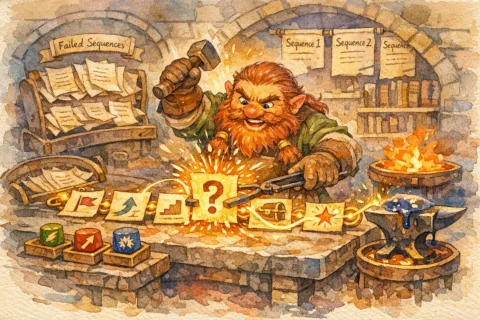
A dwarven forge guide to chaining scenes around one sharp question so each sequence escalates, turns, and pays off instead of just circling the anvil.
EXAMPLE: Dwarven Council Scene used throughout this article.
I. From Single Sparks to a Chain of Blows
Most apprentices learn to strike once.
One good emotional beat. One sharp scene. A single argument that sings. And then—because no one taught them otherwise—they string scenes together like mismatched ingots: this one is angry, this one is sad, this one is exposition, that one is a joke.
The result?
- Chapters that feel busy but somehow not moving toward anything.
- Repetitive arguments: “Wait, we’re still talking about whether to go into the tunnel three scenes later . . .”
- Setups that never pay off; questions that simply fade into the stone.
Sarah stands in the forge before a long bar of metal, not a single chunk of ore.
She taps the length of it with her hammer. “One good strike is fine,” she says. “But to shape a blade, you need a sequence of blows that all land in the same direction.”
That’s what this article is about. Not just scenes, but sequences. Clusters of scenes that:
- Chase one clear question (“Will the dwarves save the trapped miners?”)
- Escalate pressure and risk with each pass
- Deliver a definite yes / no / yes-but / no-and answer that changes the story’s course
By the end, you’ll be able to:
- Frame strong sequence questions that keep readers leaning forward
- Map and test your sequences for escalation instead of repetition
- Use a simple Sequence Blueprint worksheet to refit wandering scenes into tight, satisfying mini-arcs
We’ll anchor everything in one sequence from Darrik Stonehand’s saga, beginning with the council chamber scene you’ve already read.
II. What Is a Sequence?
Let’s align our terms so we’re swinging at the same rhythm.
The Four Scales
- Beat – the smallest shift; one emotional, informational, or moral turn.
- Scene – a unit of time and action where a character pursues a goal and something changes.
- Sequence – a chain of 2–5 scenes locked together around one dramatic question.
- Act – a major movement in the story, formed by multiple sequences.
Forge version:
- Beat = one hammer strike.
- Scene = one pass at the forge (heat, strike, quench).
- Sequence = a specific task at the forge—say, shaping the blade’s edge.
- Act = forging the entire weapon from raw bar to tempered steel.
Where a Sequence Begins and Ends
A sequence:
Begins when the question is posed and your characters commit to pursuing it.
Ends when that question is clearly answered:
- Yes
- No
- Yes, but (success with a cost)
- No, and (failure plus extra trouble)
It is:
- Longer than one scene, because one scene usually can’t show all the swings
- Shorter than an act, because the sequence is one mini-task inside a larger movement
If an arc sprawls over ten scenes and three different questions, that’s probably not one sequence, it’s an act (or a messy draft).
III. The Heart of a Sequence: A Strong Question
A sequence lives or dies on its question. Weak question, weak metal.
What Makes a Strong Sequence Question?
Three traits:
1. Specificity
Bad: “Will they get through the winter?”
Better: “Can they secure a grain deal with the Earl before the first snow?”
- The second implies:
- a concrete task (deal-making)
- a deadline (first snow)
- a clear place where the answer will be known (the signing, or breaking, of a deal)
2. Stakes
What’s at risk if the answer is yes or no?
- Lives?
- Love?
- Status?
- Survival?
- Moral integrity?
3. Plausible Yes and No Paths
The question must be genuinely open. Readers should be able to imagine how the characters might win, and also how they might lose.
If “yes” is obviously guaranteed, that’s not a sequence question, it’s a formality.
If “no” is unthinkable because you’ve made one outcome the only logical option, the tension evaporates.
This is all based upon the story logic, not the trope expectations such as romance's HEA (happily ever after).
The Tunnel 7 Question
In Darrik Stonehand’s saga, one obvious sequence question is:
“Will the dwarves save the trapped miners before the air runs out?”
Stake stack:
- External: Lives of Darrik’s crew in Tunnel 7
- Political: Leverage in negotiations with the human Earl (Tunnel 7’s silver seam funds the grain tithe)
- Social: Trust in the Council and the stability of dwarven law
- Internal: Darrik’s integrity and ability to live with himself
This question starts in the council chamber the moment Darrik petitions the High Council to reopen the tunnel and is struck down with a single-word verdict:
“Denied.”
From that point on, the story is no longer about “Is Tunnel 7 dangerous?” but:
- Will they attempt a rescue anyway?
- If so, can they pull it off before the mountain or the law crushes them?
The sequence will end when we can answer that rescue question clearly:
- Yes
- No
- Yes, but (lives saved at a cost)
- No, and (they fail and trigger something worse)
Everything in between is the sequence.
IV. The Anatomy of a Sequence Mini-Arc
On the sequence level, you still want a clean arc:
Goal → Conflict → Outcome
framed as Question → Escalation → Answer.
1. Inciting Scene of the Sequence
- Introduces the sequence question
- Articulates or heavily implies the stakes
- Shows characters committing to pursue a goal
For Tunnel 7:
- Darrik petitions the Council
- The Council refuses and seals Tunnel 7
- Sarah hints that if he goes now, he goes without blessing
The rescue question is now sharp:
“Do we attempt an unauthorized rescue, or do we accept their deaths?”
2. Progress Scenes
One scene rarely takes you from question to answer. You need progress scenes that:
- Move the characters toward the goal
- Gaining resources, allies, information, positioning
- And simultaneously increase complications and costs
In a healthy sequence:
- Each progress scene changes the odds:
- One makes success seem more likely
- The next reveals a danger that makes failure loom larger, and so on . . .
3. Crisis / Pivot Scene
This is the knife-edge of the sequence:
- The original plan fails, or
- A new, severe cost appears, or
- Someone betrays, withdraws, or escalates in a way that forces a hard choice
Here the sequence question moves from “Will they try?” to “What are they willing to sacrifice to see it through?”
4. Payoff Scene
Finally:
- The question is answered (Yes / No / Yes-but / No-and)
- The consequences spill forward into the next sequence
There must be a clear value shift, even at this “mini” level:
- +Hope-of-rescue → –Loss-of-crew (tragic).
- –Chance-of-rescue → +Lives-saved-but-political-cost (bittersweet).
- +Faith-in-the-Council → –Faith / +Personal-agency (as in the council scene).
Think of the sequence as a mini-story embedded inside the larger tale:
- It starts somewhere specific
- It changes meaningfully
- It ends in a different, stable state
V. Mapping the Tunnel 7 Rescue Sequence
Let’s sketch a full Tunnel 7 Rescue Attempt sequence using the council chamber scene as the inciting event.
We’ll imagine some downstream scenes (planning, descent, crisis, payoff) to show how you can build a sequence around a piece of fiction you already have.
Sequence Name
“Tunnel 7 Rescue Attempt”
Sequence Question
“Will the dwarves save the trapped miners before the air runs out?”
Proposed Six-Scene Chain
Scene 1 – Council Chamber (Inciting)
- Existing scene: The High Council hearing
- Darrik petitions to reopen Tunnel 7
- Thrain refuses, invoking his dead son and the risk of further collapse
- Sarah proposes a small, “lives-only” rescue crew with no mining
- Thrain hammers the bench: no crews, Tunnel 7 remains sealed
- As Darrik leaves, Sarah warns:
If you go, you go without the Council’s blessing.
Sequence work:
Question is raised: attempt a rescue or accept the deaths?
Stakes laid out:
- Lives in the tunnel
- Winter grain
- Political leverage
- Dwarven law and exile
Darrik’s internal commitment sparks. He would rather face falling stone than live with doing nothing.
Scene 2 – The Quiet Corridor (Planning)
Location: Tunnels outside the council chamber; later, a secluded alcove near the tool caches.
Darrik and Sarah (or Darrik + one trusted ally) weigh the cost of defiance:
- Exile
- Shaved braids
- Loss of clan protection
They outline a rescue plan:
- Four dwarves: Darrik, Master Hothric, Bram, Torvald.
- Route through the old aquifer tunnel to skirt the worst fault.
- Use pre-forged steel jacks at Junction Three.
Sequence work:
The question sharpens from “will they try?” to “are they willing to pay the social price?”
The odds of a Yes (attempt rescue) increase:
- They now have a concrete path
Value shift:
- –Obedient Hope → +Defiant Duty
Scene 3 – Gathering the Crew and Tools
Location: Miners’ quarters, tool caches, forge alcoves.
Darrik recruits volunteers:
- Some refuse out of fear or loyalty to the Council.
- Others commit, anchoring the emotional cost of the attempt.
- They retrieve: lamps, steel jacks, bracing timbers, rope and masks.
- They must avoid Council eyes; maybe a guard turns a blind eye.
Sequence work:
Concrete steps toward the goal: the Yes path is now in motion.
Each volunteer brings stakes:
- If Bram comes, Lysa’s fate becomes even sharper.
- If Torvald comes, his age/experience adds risk in one direction and safety in another.
Value shift:
- +Individual Fear → +Shared Commitment.
Odds of rescue: Yes odds ↑ (they are better equipped, but risk is now spread across more lives).
Scene 4 – Descent into Tunnel 7
Location: Old aquifer tunnel, approaching Tunnel 7 collapse.
Physical danger rises:
- Tremors
- Falling dust
- Echoes of past collapses
The plan encounters its first serious complication:
- A side passage is blocked
- A jack fails
- Gas pockets force them to change route
Emotions spike:
- Panic
- Claustrophobia
- Guilt
Sequence work:
Transform abstract danger into immediate physical stakes.
Odds of success drop with each complication:
- Yes odds ↓.
Value shift:
- +Prepared Confidence → –Immediate Peril.
Scene 5 – Crisis at the Fault Line
Location: Just shy of the trapped miners, at a critical fault.
They reach a point where:
- One more brace might save those ahead
- But risks bringing the entire corridor down on the rescue team
Hard choice:
- Retreat and condemn the trapped crew, or
- Push forward and risk everyone
Someone may offer a sacrifice:
- Stay behind to hold a brace
- Take a more dangerous solo route
Sequence work:
This is the pivot scene:
- The question~ is no longer “Can we get there?” but “What are we willing to pay to try?”
Value shift:
- +Life-of-Few vs +Life-of-Many → a knife-edge dilemma.
Odds are uncertain; we are at maximum tension.
Scene 6 – Payoff
Location: Either in the tunnel or later in the hall.
The sequence question is answered:
Yes, but
- They reach the crew, but one rescuer dies or is maimed.
- Or they save only some, and return to political backlash.
No, and
- They fail to save the crew, and their defiance triggers Council punishment or human intervention.
Consequences ripple:
- Grief or relief.
- Political fallout with Thrain and the Earl.
- New questions: Will Darrik be exiled? Will the Earl use this disaster?
Sequence work:
The Tunnel 7 question is closed.
A new question for the next sequence emerges:
- “Will Darrik survive the Council’s judgment?”
- “Will the Earl use the disaster to gain control of the mines?”
This is a well developed 6-scene mini-arc:
- Clean entry
- Rising stakes
- Crisis
- Clear answer
VI. Common Sequence Failures
Most “wandering middle” problems are actually sequence problems.
1. Repetition
Symptoms:
Multiple scenes rehashing the same debate with no new:
- Stakes
- Information
- Decisions
Bad Tunnel 7 version:
- Scene 1: Council debates the tunnel. “We’ll decide later.”
- Scene 2: Council debates the tunnel. “We’ll decide later.”
- Scene 3: Council debates the tunnel. “We’ll decide later.”
Nothing changes, so the sequence question never moves.
Fix:
Make each scene irrevocably change the situation:
- Scene 1: Council refuses and seals Tunnel 7.
- Scene 2: Someone breaks rank and leaks the rescue plan.
- Scene 3: Council responds to that disobedience (sanctions, threats, new stakes).
Each scene must alter the odds or the cost of “Will we save the miners?”
2. Filler Scenes
Symptoms:
A charming tavern scene appears in the middle of the rescue arc, but it:
- Doesn’t change the plan
- Doesn’t reveal crucial stakes
- Doesn’t affect their chances of success
Fix:
Tie the scene directly into the sequence:
- Recruit a key brace-man in that tavern.
- Learn that the Earl has sent his own men toward the mine.
Or move it to a different section of the book where it supports a different sequence (e.g., politics or romance).
Every scene inside the Tunnel 7 sequence must be about the rescue question, directly or by significantly altering its stakes.
3. Unresolved Questions
Symptoms:
- You pose the question (“Will they rescue the miners?”)
- Then cut away to another subplot
- And never clearly answer it on the page
Readers remember. They may not know why they’re dissatisfied; they just feel like the story dropped a bar of hot metal on the floor and walked away.
Fix:
In your blueprint, make sure every sequence has:
- A clear start scene (question posed)
- A clear payoff scene (question answered)
If the answer happens off-page:
- Deliver it via messenger, rumor, or fallout
- But make it explicit enough that the reader can mark it as resolved
4. Side-Quest Bloat
Symptoms:
Across four scenes, you’re juggling:
- Rescue the miners?
- Save the marriage?
- Spy on the Earl?
- Recover the missing heirloom?
None of these get a full mini-arc; all of them feel under served.
Fix: Choose one primary sequence question to structure the cluster of scenes.
Let other threads be:
- Background pressures, or
- Moved to their own dedicated sequences later
Sequence equals one bar of metal. Don’t try to forge a sword, a horseshoe, and a cooking pot out of the same strip at the same time.
VII. The Sequence Blueprint Worksheet
You can put this in Notion, Obsidian, Excel, or on paper. Sarah prefers slate tablets, but she’s old-fashioned.
Core Fields
- Sequence Name
- Sequence Question (yes/no style)
- Stakes – internal, interpersonal, external
- Scenes in Sequence (in order):
- Scene # / Title
- POV
- Scene Goal
- How it changes the odds of a Yes or No
- Value Shift (+ → – or – → +)
- Answer – Yes / No / Yes, but / No, and
- Fallout / Next Sequence Hook
Example: Tunnel 7 Rescue Attempt
Here’s a minimalist chunk of the worksheet:
| Scene # | Title | POV | Scene Goal | Odds Shift | Value Shift |
|---|---|---|---|---|---|
| 1 | Council Chamber | Darrik | Win official rescue approval | Yes odds ↓ (Council seals Tunnel 7) | +Faith in Council → –Faith / +Personal Burden |
| 2 | Planning in Corridor | Darrik | Decide whether to defy the Council’s ruling | Yes odds ↔ (internal commitment, no action yet) | –Obedience → +Defiant Duty |
| 3 | Gathering the Crew | Bram | Secure volunteers and gear | Yes odds ↑ (crew + tools obtained) | +Individual Fear → +Shared Commitment |
| 4 | Descent into Tunnel | Darrik | Reach the trapped miners alive | Yes odds ↓ (physical danger escalates) | +Prepared Confidence → –Immediate Peril |
| 5 | Crisis at the Fault | Sarah | Choose between retreat and sacrifice | Yes odds ? (balanced on a knife-edge) | +Life-of-Few vs +Life-of-Many → moral tension peak |
| 6 | Payoff | Darrik | Live with the outcome of the attempt | Answer given (Yes / No / variant) | Sequence value settles into a new stable state |
You don’t need fancy notation. The key is to answer, for each scene:
“Does this scene make success feel more likely or less? And what value actually changes here?”
If you can’t answer it, the scene does not belong in that sequence, or it needs revision.
VIII. Testing the Rhythm: Escalation vs Circling
Once the blueprint is filled, read it like a heartbeat chart.
Rhythm Check #1: Direction of the Odds
Mark each scene:
- Yes odds ↑
- Yes odds ↓
- Yes odds ↔
- Knife-edge / ?
Healthy sequence rhythm example:
- Scene 1: Yes odds ↓ (Council refuses; problem worsens).
- Scene 2: Yes odds ↔ (internal commitment; still illegal).
- Scene 3: Yes odds ↑ (crew assembled).
- Scene 4: Yes odds ↓ (tunnel nearly kills them).
- Scene 5: Knife-edge (could go either way).
- Scene 6: Final answer.
Red flag:
- If your odds line looks like: ↔, ↔, ↔, ↔
- Or all ↑ with no counter-pressure
Then you’re not escalating, you’re coasting.
Rhythm Check #2: Value Shifts
Pick one key value:
- Trust in Council
- Physical Safety
- Leverage with Earl
- Belonging to the Clan
Track it across the scenes:
- Does it shift meaningfully each time?
- Or stay flat until the last page?
A Tunnel 7 version:
- Scene 1: +Trust in Council → –Trust / +Burden on Darrik
- Scene 2: –Obedience → +Defiant Duty
- Scene 3: +Isolated Guilt → +Shared Risk
- Scene 4: +Plan-on-paper → –Reality-of-death
- Scene 5: +Abstract “lives vs law” → +Immediate “who dies?” decision
- Scene 6: Value locks into its new state (e.g., +Personal honor, –Political safety)
If two scenes in a row don’t budge that value, you’re likely circling.
IX. Using Sequences to Revise a Wandering Draft
Now, how do you apply this to the unruly beast already on your desk?
Step 1: Identify Existing Sequences
Skim your draft and jot down:
- Every question that stretches across 2–5 scenes.
- Examples:
- “Will they escape the city?”
- “Will she confess the lie before the festival?”
- “Will they pull off the heist without killing anyone?”
Those are your candidate sequences.
Step 2: Fill Out a Blueprint for Each
For each candidate sequence write down:
- Sequence question
- Stakes
- List of scenes in order
Be honest. If a scene doesn’t actually affect the question, mark it.
Step 3: Re-forge the Metal
Using the blueprint:
- Cut or move scenes that don’t alter odds or values
- Combine repetitive scenes that rehash the same stage of the argument
- Add missing structural pieces:
- An inciting scene where the question is clearly posed
- A crisis scene that forces a hard choice
- A payoff scene that clearly answers the question
Step 4: Re-read as a Reader
Now read just that sequence, end to end and ask:
- Does the sequence start clearly?
- (Do I know what everyone’s trying to do and why it matters?)
- Does tension build, with real reversals of fortune?
- (Do the odds swing, or do we just march straight to victory?)
- Does the payoff feel inevitable but surprising?
- (Could I see this as one of several possible outcomes, not the only one?)
If yes, you’ve forged a functioning mini-arc.
If no, go back to the blueprint and adjust strikes.
X. Closing
At the end of a long day, Sarah holds up two bars of metal to her apprentices. The first is dented all over, random hammer marks with no pattern. The second has a clean taper along one edge, each strike landing where the last one left off, the metal bending in one clear direction.
“Any fool can swing a hammer,” she says. “A smith arranges blows so the metal moves somewhere.”
Sequences are how you arrange your blows.
- Scenes are not meant to wander alone
- They belong in chains, each link pulling the reader toward an answer
You don’t have to blueprint every sequence in your book tomorrow. Start small:
- Pick one messy arc that’s bugging you
- Name its sequence question
- List the scenes that belong to it
- Use the Sequence Blueprint to test:
- Does each scene change the odds?
- Does each scene shift a key value?
- Does the sequence end with a clear answer and fallout?
Do that a few times, and you’ll find your drafting instinct changing. You’ll stop thinking in “chapter 7, chapter 8” and start thinking in:
- “The rescue attempt sequence”
- “The grain deal sequence”
- “The betrayal sequence”
That’s how you move from isolated sparks to a chain of blows that actually shapes the story. That’s the work of a master.